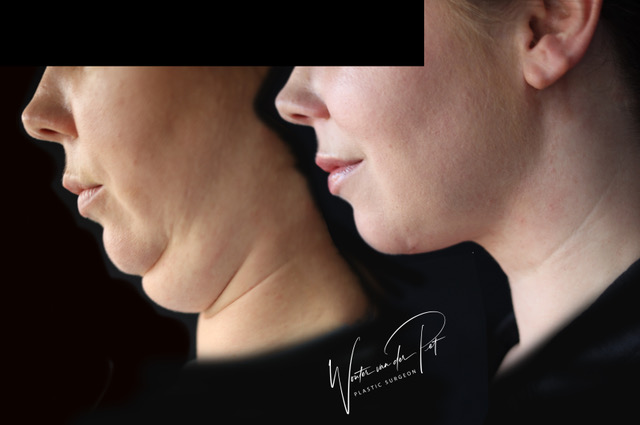
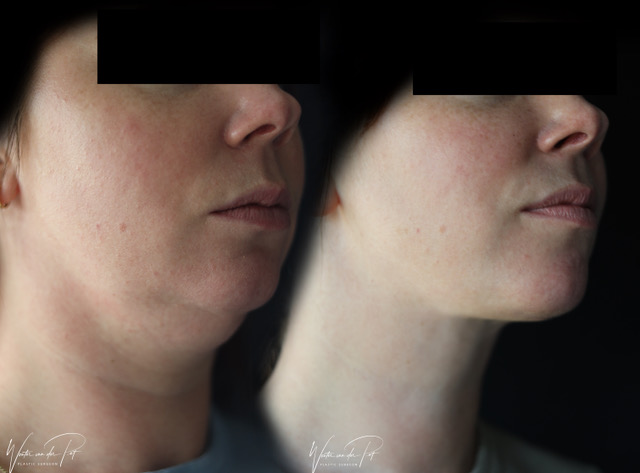
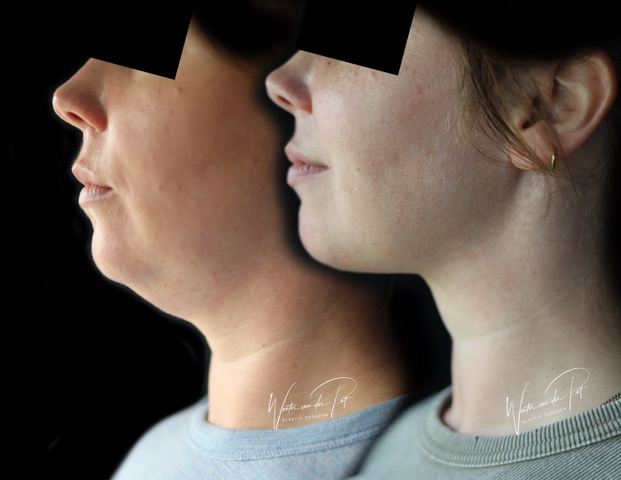
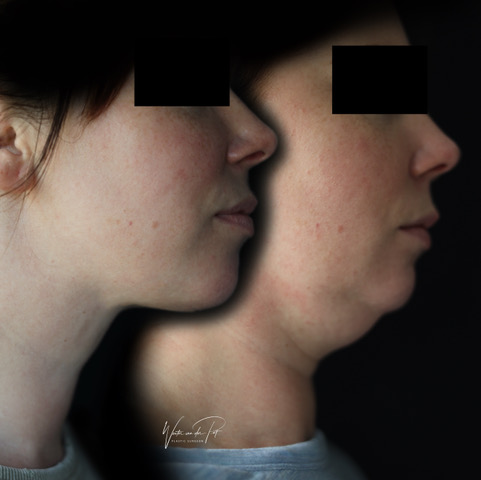
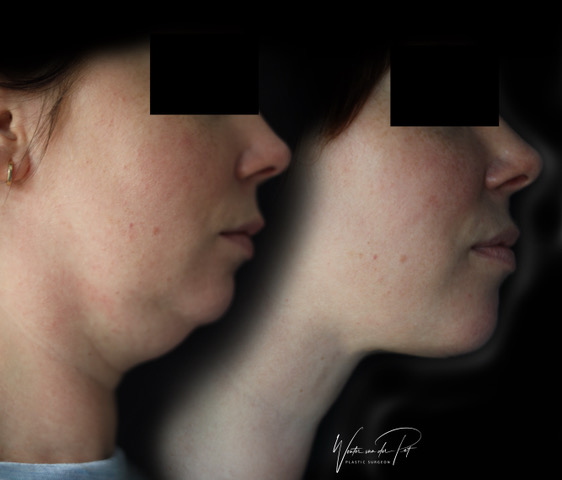
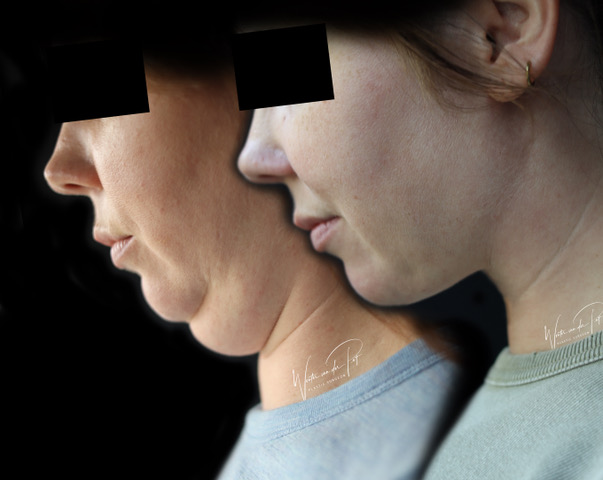
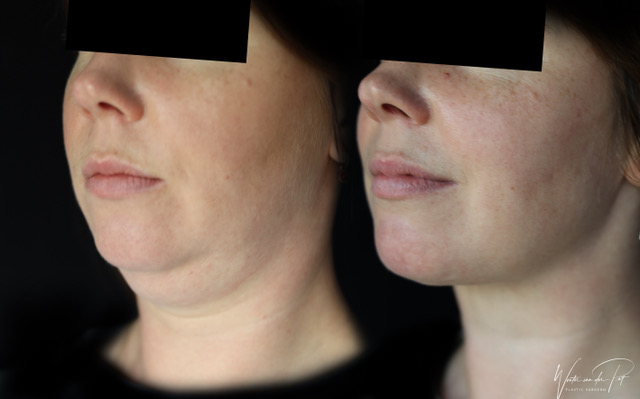
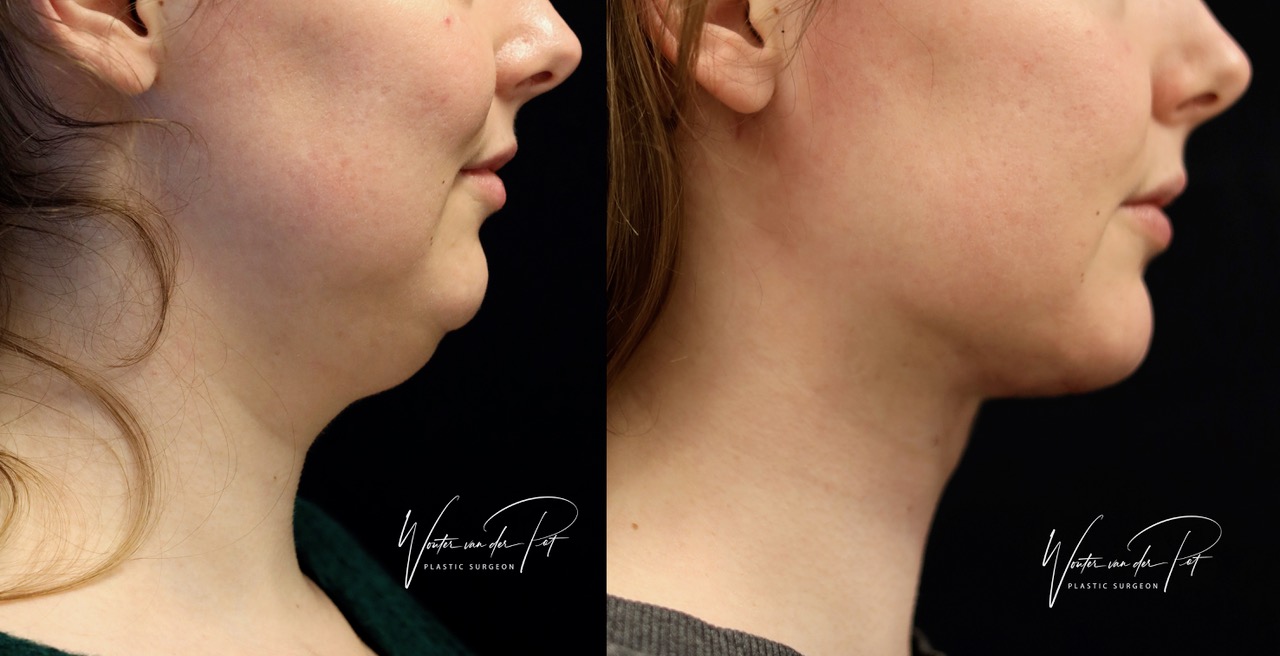
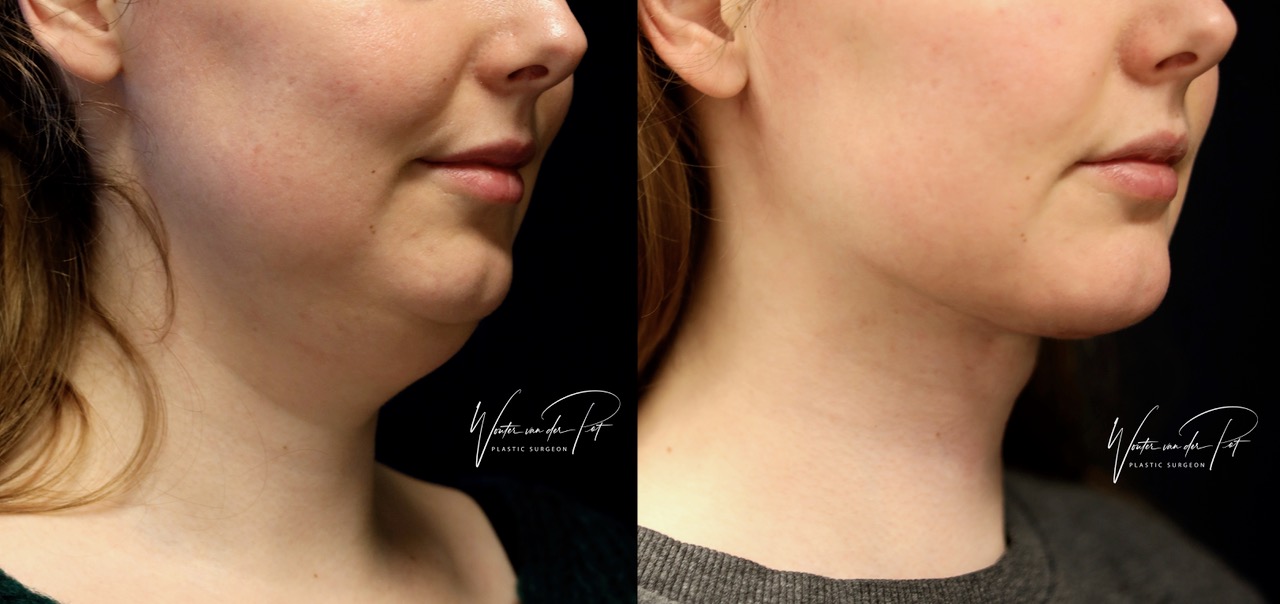
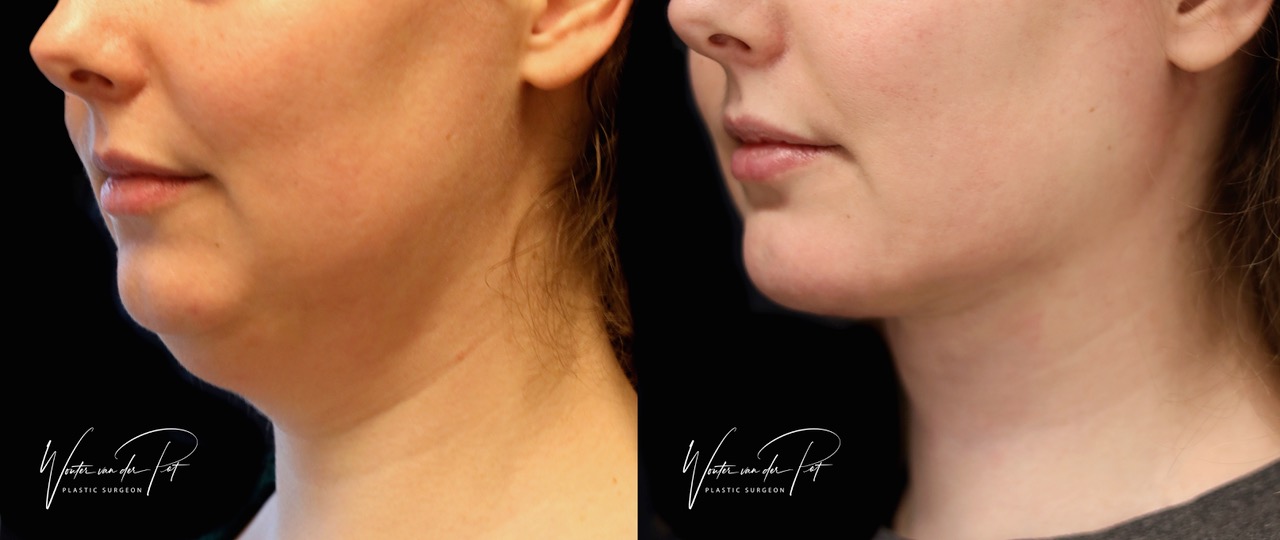
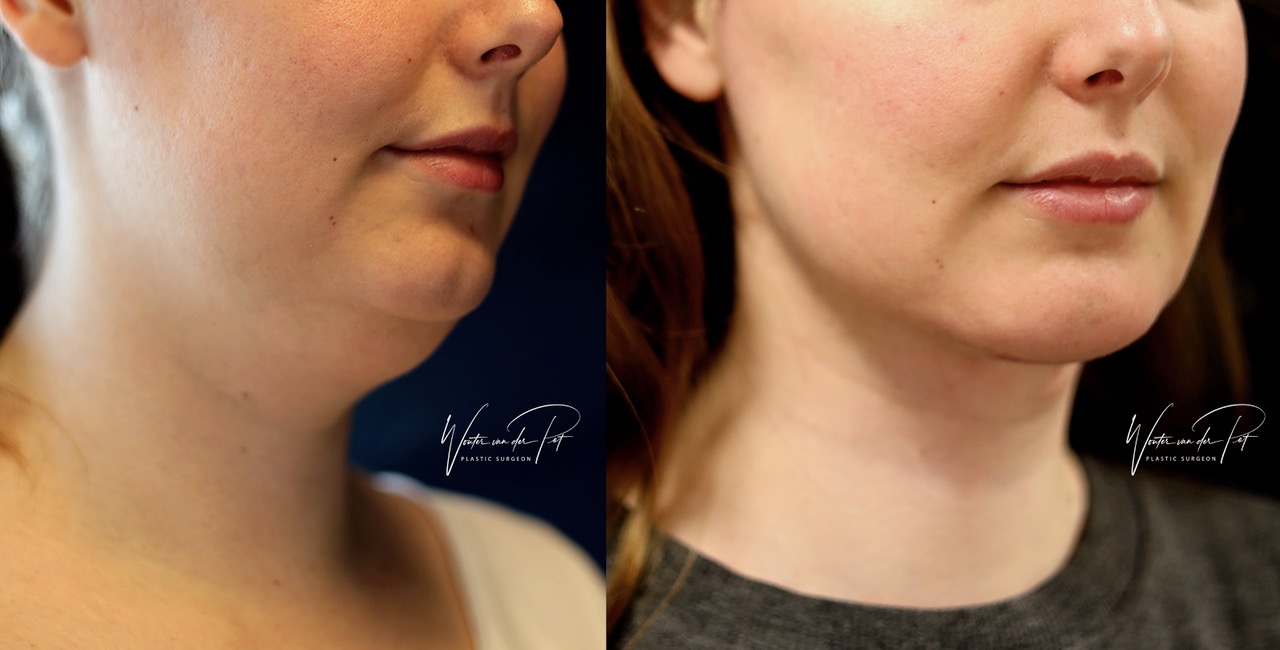
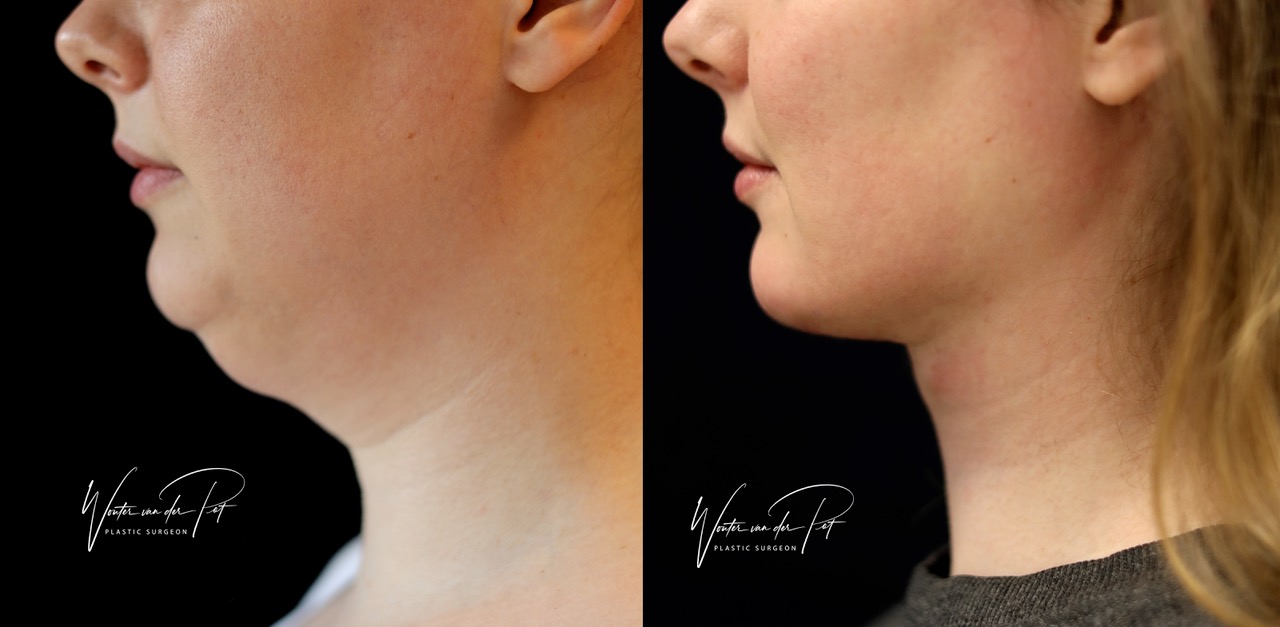
A beautiful neck is defined by the angle between the jaw and the neck. In some people, this angle is naturally less sharp due to a fuller double chin or deeper fat layers beneath the neck muscle. In others, it develops gradually as tissues begin to sag over time.
A deep neck lift is a specialised procedure in which we treat all relevant layers of the neck through one small incision hidden in the skin crease under the chin: the skin, subcutaneous fat, the platysma muscle, and—if necessary—the small salivary glands. The goal is a tight, well-defined jaw–neck angle and an elegant side profile.
Unlike submental liposuction, which removes only superficial fat, a deep neck lift works beneath the platysma muscle. This is where the fat responsible for a full double chin or a less defined jawline is often located.
Through a small incision under the chin, we can:
directly assess deep fat under direct vision and remove it precisely
suture the platysma muscle together in the midline (an internal “corset” technique)
if necessary, reduce the small submandibular salivary glands
allow the skin to redrape smoothly and tighten along with the new contours
This creates a structural and long-lasting anatomical correction. In principle, a full double chin does not return.
In this video we will try to explain why a deepplane facelift is technically superior then other techniques in most cases.
Click on a topic for more information
In younger patients (roughly up to ±30–35 years) with:
firm skin
a congenital full double chin
minimal skin laxity
a deep neck lift can be performed without a facelift.
The scar is hidden in the natural skin crease under the chin and, once healed, is barely visible.
In most facelift procedures, we routinely perform a deep neck lift as well.
A beautiful neck is not achieved by lifting the skin alone, but primarily by correcting the deeper neck structures. The combination results in:
a tighter neck
a sharper jawline
a longer-lasting result
Read also: Deep-plane facelift
Dr Van der Pot and Dr Ahmed learned and refined this technique from international colleagues who have popularised this method worldwide.
They now routinely perform deep neck lifts as part of their neck and facelift surgery and regularly present these techniques at international conferences.
Small incision in the skin fold under the chin
Treatment of fat above and below the platysma
Internal platysma corset suture
Correction of small salivary glands if necessary
Skin closes nicely without tension
The procedure is usually performed under general anaesthesia when combined with a facelift, and under local anaesthesia when it is a standalone deep neck lift.
Tighter double chin
Sharp jaw-neck angle
Attractive profile in side view
Structural, permanent anatomical improvement
There is only one small scar under the chin, hidden in the natural skin fold.
When combined with a facelift, the usual facelift scars around the ear are added.
Swelling and mild firmness during the first weeks
Socially presentable after approximately 2 weeks
Final contour after 3–6 months
As with any operation, there are general risks such as:
bleeding (hematoma)
infection
delayed wound healing
an unfavorable scar
Specific to the deep neck lift:
temporary asymmetrical movement of the lower lip due to bruising of a small nerve branch (neuropraxia) — this almost always recovers within 3–6 weeks
a small irregularity or slight indentation in the neck
residual swelling lasting longer than average
Serious complications are rare. During the consultation, we always discuss your individual risk profile.
In younger patients (roughly up to ±30–35 years) with:
firm skin
a congenital full double chin
minimal skin laxity
a deep neck lift can be performed without a facelift.
The scar is hidden in the natural skin crease under the chin and, once healed, is barely visible.
In most facelift procedures, we routinely perform a deep neck lift as well.
A beautiful neck is not achieved by lifting the skin alone, but primarily by correcting the deeper neck structures. The combination results in:
a tighter neck
a sharper jawline
a longer-lasting result
Read also: Deep-plane facelift
Dr Van der Pot and Dr Ahmed learned and refined this technique from international colleagues who have popularised this method worldwide.
They now routinely perform deep neck lifts as part of their neck and facelift surgery and regularly present these techniques at international conferences.
Small incision in the skin fold under the chin
Treatment of fat above and below the platysma
Internal platysma corset suture
Correction of small salivary glands if necessary
Skin closes nicely without tension
The procedure is usually performed under general anaesthesia when combined with a facelift, and under local anaesthesia when it is a standalone deep neck lift.
Tighter double chin
Sharp jaw-neck angle
Attractive profile in side view
Structural, permanent anatomical improvement
There is only one small scar under the chin, hidden in the natural skin fold.
When combined with a facelift, the usual facelift scars around the ear are added.
Swelling and mild firmness during the first weeks
Socially presentable after approximately 2 weeks
Final contour after 3–6 months
As with any operation, there are general risks such as:
bleeding (hematoma)
infection
delayed wound healing
an unfavorable scar
Specific to the deep neck lift:
temporary asymmetrical movement of the lower lip due to bruising of a small nerve branch (neuropraxia) — this almost always recovers within 3–6 weeks
a small irregularity or slight indentation in the neck
residual swelling lasting longer than average
Serious complications are rare. During the consultation, we always discuss your individual risk profile.
Click on the subject to find more information about this treatment
Together, we will find the treatment that suits you best, with personal attention and honest advice.
Not every neck requires the same solution.
During a consultation, we analyse:
skin quality
fat distribution
muscle structure
the jawline
and determine whether a deep neck lift is the right choice for you—either as a standalone procedure or as part of a facelift.
We would be happy to welcome you for a personal consultation at Gooimeer Clinics.
Click on an questions to see the answer
Is liposuction of the double chin not sufficient?
In the case of superficial fat, sometimes yes. However, deep fat under the neck muscle can only be corrected with a deep neck lift.
Can I combine a Deep Neck Lift procedure with a Facelift?
Yes. At Gooimeer Clinics, the deep neck lift is a standard part of our deep-plane facelift.
Komt de onderkin terug na een Deep Neck Lift?
No. The deep-seated fat is structurally removed and the anatomy is permanently altered.
Is the scar visible after a Deep Neck Lift?
The incision is made in the skin fold under the chin and usually heals almost imperceptibly.
When will I be presentable again after a Deep Neck Lift?
After approximately 10–14 days. Swelling will then gradually continue to subside.
Can a Deep Neck Lift also be performed under local anaesthetic?
For a standalone deep neck lift: yes.
When combined with a facelift: usually under general anaesthesia.
Click on an article to see more information
Sign up for our newsletter to stay up to date with the latest news.
Follow us on social media to stay up to date with our practice and see the latest stories.